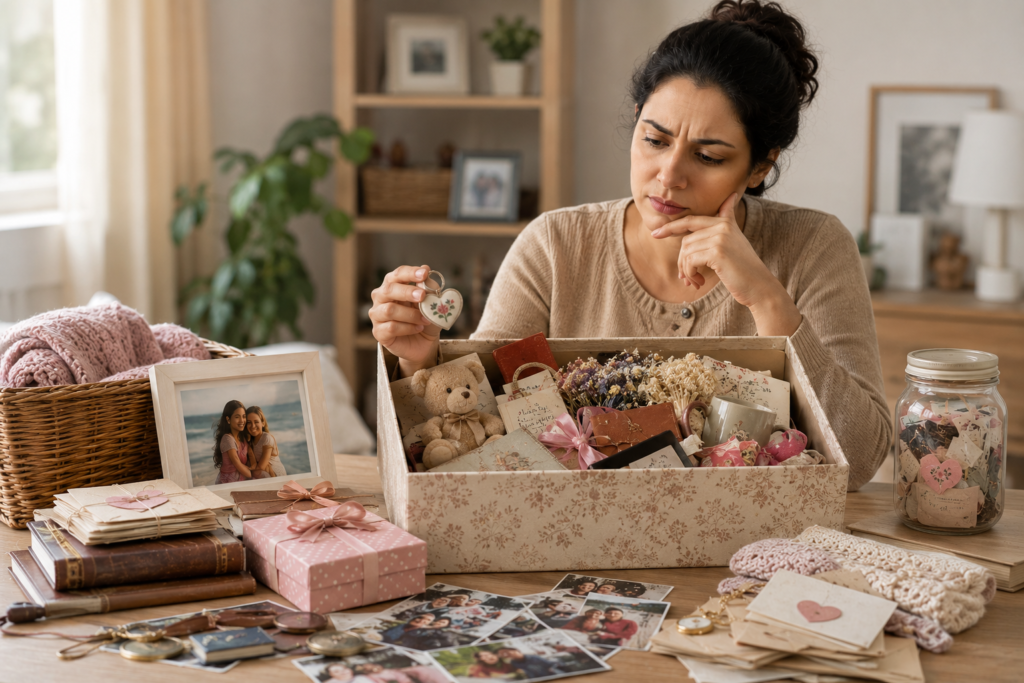
Sentimental clutter is one of the hardest types of clutter to deal with.
You’re not just deciding whether to keep an object — you’re deciding what it means, what memory it holds, and sometimes even what version of yourself you want to hold onto. Especially when the item belonged to someone you deeply loved and lost.
That’s why decluttering sentimental items feels emotional in a way ordinary decluttering never does.
But here’s something I’ve learned through my minimalism journey:
Memories live in us, not inside objects.
Why Sentimental Clutter Feels So Difficult
Most sentimental clutter is connected to:
- people we love,
- past versions of ourselves,
- important milestones,
- or fear of forgetting.
Sometimes we keep things because:
- “Someone gifted this to me.”
- “My child used this once.”
- “I spent a lot of money on it.”
- “This reminds me of a happy time.”
- “What if I regret throwing it away?”
- “My mother’s memory is in this.”
- “What will people think if I declutter a passed-away relative’s belongings?”
And slowly, our homes become storage spaces for emotions instead of peaceful places to live.
The Difference Between Memory and Clutter
Not every meaningful item is clutter.
A few deeply loved and intentionally kept items can bring comfort and joy. The problem begins when we keep everything out of guilt.
When every object becomes “special,” nothing truly feels special anymore.
Minimalism helped me understand that sentimental items should be curated — not accumulated endlessly.
After my mother passed away, I created a small memory box with some of her personal belongings: her ID card, spectacles, watch, and purse. I kept one of her favourite sarees and donated the rest. Keeping a few meaningful things felt far more peaceful than holding onto everything.
Start With the Least Emotional Items
Do not begin with old photographs, wedding items, or your child’s baby clothes.
Start smaller:
- greeting cards,
- old notebooks,
- expired keepsakes,
- duplicate souvenirs.
Building decision-making confidence first makes the emotional categories easier later.
Ask Yourself These Questions
When decluttering sentimental clutter, I ask myself:
- Would I remember this memory without this object?
- Am I keeping this from love or guilt?
- Does this item actually honour the memory?
- Would I display or use this if I truly valued it?
- Am I keeping too many versions of the same memory?
These questions help separate meaningful keepsakes from emotional storage.
Keep the Best, Not Everything
You do not need:
- every childhood drawing,
- every baby outfit,
- every gift,
- every travel souvenir,
- every old photo print.
Keep a few truly meaningful pieces instead.
One beautiful memory box is more valuable than ten overflowing storage bins you never open.
Photographs Can Help
Sometimes taking a photograph of an item is enough.
Especially for:
- children’s artwork,
- bulky souvenirs,
- old letters,
- sentimental furniture,
- clothing with memories attached.
You preserve the memory without keeping the physical clutter.
Guilt Is Not a Good Reason to Keep Something
This was one of the biggest lessons for me.
A gift has already served its purpose when it was given with love. Keeping it forever out of guilt does not make the relationship stronger.
You are not disrespecting someone by letting go of an unused object.
Sentimental Clutter and Family Expectations
In many Indian homes, sentimental clutter is deeply tied to family culture:
- saving things “for the future,”
- passing items down,
- attaching emotions to objects,
- or feeling wasteful when letting go.
I grew up seeing this too.
But peace in a home also matters. A home should not feel like a storage unit filled with generations of guilt and “just in case” items.
Instead of saving everything physically, I believe we should focus on preserving what truly matters for future generations — valuable assets, meaningful memories, financial stability, and emotional well-being.
Decluttering Is Not Erasing Your Past
This is important.
You are not throwing away your memories.
You are making space to enjoy your present life more peacefully.
Sometimes holding onto too much physically can make us emotionally heavier too.
My Simple Rule for Sentimental Items
I keep:
- what I truly love,
- what I intentionally use or display,
- and what genuinely adds meaning to my life.
Everything else, I give myself permission to let go.
Final Thoughts
Decluttering sentimental clutter takes time. It cannot always be done in one day — and it shouldn’t be.
Do not try to declutter everything in one go. It can become emotionally overwhelming.
Go slowly. Be honest with yourself. Keep the memories that truly matter.
Minimalism is not about becoming emotionless.
It is about choosing what deserves space in your home — and in your life.
Sometimes, letting go is not losing the memory.
It is protecting your peace.
Vasanthi Shankar Digital download Store
Link – https://vasanthishankar.myinstamojo.com/
Vasanthi Shankar Amazon Store Front Link – https://www.amazon.in/shop/mrs.shankarsrecipes
Vasanthi Shankar WhatsApp Channel – https://www.whatsapp.com/channel/0029VaBNmt22v1IqxpnjLr2W
Things I use for filming my videos- https://amzn.to/4ausvPC