
Your 30s can be one of the most important decades of your financial life.
Your income may be increasing, but so are your responsibilities. You may be thinking about buying a house, getting married, raising children, supporting parents, changing careers, or simply creating a more secure future.
The good news?
You don’t need to be extremely wealthy to build a strong financial foundation.
You need a simple plan, consistent habits, and the discipline to follow them.
Here is a practical financial plan you can start following in your 30s.
1. Know Where Your Money Is Going
Before trying to save or invest more, understand your current financial situation.
For one month, track:
- Salary or other income
- Rent or home-loan EMI
- Groceries
- Electricity and other bills
- Transportation
- Insurance
- Shopping
- Eating out
- Subscriptions
- Investments
- Other miscellaneous expenses
Don’t judge your spending while tracking it.
The goal is simply to understand where your money is going.
You cannot improve what you don’t measure.
2. Create a Realistic Monthly Budget
A budget doesn’t mean saying “no” to everything you enjoy.
It means deciding where your money should go before you spend it.
A simple starting point could be:
Income → Savings & Investments → Needs → Wants
For example, if you earn ₹60,000 per month, you might decide in advance how much should go toward household expenses, savings, investments, insurance and personal spending.
Your percentages don’t have to perfectly follow any popular budgeting rule.
Your budget should reflect your income, responsibilities and goals.
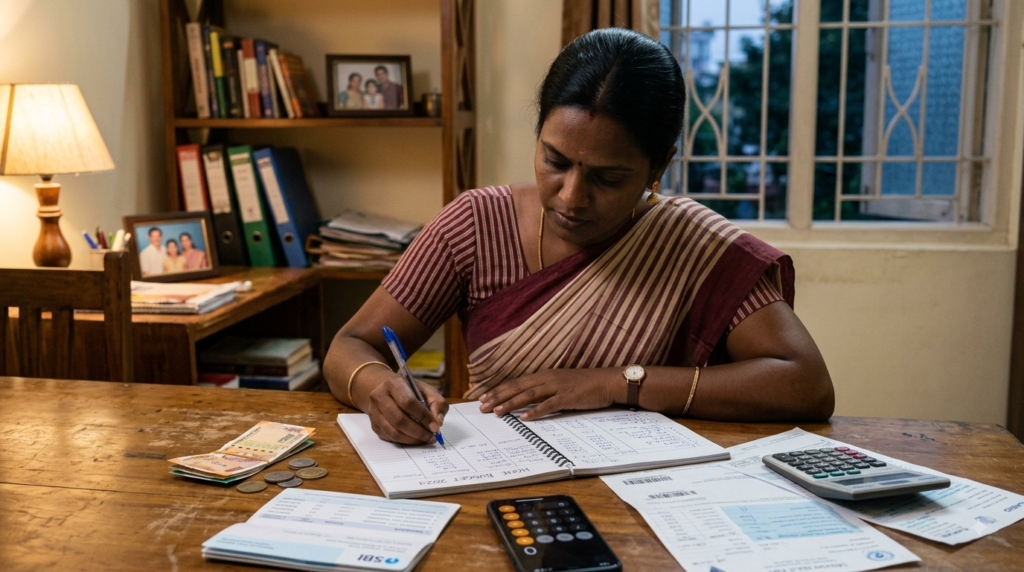
Check Vasanthi Shankar Digital Download Store for Budget Template Manual and Excel
3. Build an Emergency Fund
An emergency fund is one of the most important financial priorities in your 30s.
Unexpected expenses can happen at any time:
- Job loss
- Medical expenses
- Major home repairs
- Family emergencies
- Unexpected travel
- Temporary loss of income
Try to gradually build an emergency fund covering around 3–6 months of essential expenses.
If your monthly essential expenses are ₹40,000, for example, a 3-month emergency fund would be ₹1.2 lakh.
You don’t have to build it overnight.
Start with ₹5,000 or ₹10,000 a month and keep building it.
4. Get Adequate Insurance
Your financial plan shouldn’t only focus on growing money.
It should also protect the money you’ve already built.
Consider appropriate:
- Health insurance
- Life insurance, if someone depends on your income
- Personal accident cover where appropriate
Don’t choose insurance simply because someone recommends a particular policy.
Understand what you are buying, how much coverage you need, exclusions, and the costs involved.
5. Eliminate Expensive Debt
Not all debt is equally harmful.
High-interest debt, especially revolving credit-card debt, can seriously damage your financial progress.
Make a list of your debts and note:
- Outstanding amount
- Interest rate
- Minimum payment
- Monthly EMI
Prioritize expensive debt and create a repayment strategy.
Once high-interest debt is under control, the money that was going toward interest can be redirected toward savings and investments.

Check Vasanthi Shankar Digital Download Store for Debt Tracker
6. Start Investing for Your Future
Saving money is important.
But over long periods, investing can help your money grow and work toward your financial goals.
Your investment strategy should depend on:
- Your goals
- Time horizon
- Risk tolerance
- Income stability
- Existing savings
- Debt
- Financial responsibilities
Don’t invest simply because something is trending on social media.
Understand the investment before putting your money into it.
And remember: consistency usually matters more than trying to perfectly time the market.
7. Start Planning for Retirement
Retirement may feel very far away when you’re in your 30s.
That’s exactly why your 30s can be a powerful time to start.
Even a relatively small amount invested consistently for decades can potentially grow significantly through compounding.
Instead of asking:
“How much can I invest this month?”
also ask:
“How much will I need when I retire?”
As your income increases, consider increasing your retirement contributions rather than allowing your lifestyle to automatically expand.
8. Set Specific Financial Goals
“Save more money” is not a financial goal.
Make your goals specific.
For example:
Emergency fund: ₹2 lakh
Home down payment: ₹10 lakh
Child’s education: ₹15 lakh
Retirement: ₹X crore
Vacation: ₹1 lakh
Give every major goal:
- A target amount
- A deadline
- A monthly contribution
When your goals are clear, it becomes much easier to decide what to do with your money.
9. Avoid Lifestyle Inflation
One of the biggest financial traps in your 30s is lifestyle inflation.
Your salary increases.
Then your phone becomes more expensive.
Your car becomes more expensive.
Your shopping increases.
Your eating-out budget increases.
Your monthly expenses increase.
And somehow, you still feel like you don’t have enough money.
When you receive a salary increase, don’t spend the entire increase.
Instead, consider dividing it between:
Better lifestyle + higher savings + higher investments + financial goals
Enjoy your money—but don’t allow every increase in income to become an increase in expenses.
10. Create a Separate “Fun Money” Budget
Being financially responsible doesn’t mean living a miserable life.
Give yourself permission to spend.
Create a specific amount every month for things you enjoy:
- Shopping
- Restaurants
- Hobbies
- Entertainment
- Travel
- Beauty and self-care
When fun spending is included in your budget, you are less likely to feel guilty about spending—and less likely to binge-spend after months of extreme restriction.
11. Protect Your Financial Independence
This is particularly important for women.
Even if you are married or share finances with your family, understand your own financial situation.
Know:
- Your income
- Your savings
- Your investments
- Your insurance
- Your loans
- Your major financial documents
- Your household expenses
- Your long-term goals
Financial knowledge is not just about becoming rich.
It is about having confidence, awareness and independence.
12. Organize Your Important Documents
Create a secure place for important financial information.
Keep track of things such as:
- Bank accounts
- Investment accounts
- Insurance policies
- Loan documents
- Property documents
- Tax records
- Nomination details
- Important contact information
Review your nominations and beneficiaries periodically and update them when your circumstances change.
A well-organized financial life is much easier to manage during an emergency.
Check Vasanthi Shankar Digital Download Store for Home Binder
13. Increase Your Income
Saving has a limit.
Income doesn’t have to.
In your 30s, consider ways to increase your earning potential:
- Improve your professional skills
- Negotiate your salary
- Take certifications
- Build a side income
- Start freelancing
- Develop a small business
- Learn valuable digital skills
The goal isn’t to work endlessly.
The goal is to gradually increase the gap between what you earn and what you spend.
That gap is what gives you financial freedom.
14. Review Your Finances Every Month
Set aside 30–60 minutes once a month for a financial review.
Ask yourself:
How much did I earn?
How much did I spend?
How much did I save?
How much did I invest?
Did my debt decrease?
Am I closer to my financial goals?
What should I change next month?
This simple monthly habit can keep your finances from getting out of control.
15. Follow the “Pay Yourself First” Habit
Don’t wait until the end of the month to see how much money is left.
Usually, there won’t be much left.
Instead, when your salary arrives:
Income → Savings & Investments → Expenses
Automate your savings and investments wherever practical.
Treat your future self as one of the first people who gets paid.
A Simple Financial Plan for Your 30s
If all of this feels overwhelming, start with these seven steps:
Step 1
Track your expenses for one month.
Step 2
Create a realistic monthly budget.
Step 3
Build an emergency fund.
Step 4
Pay off high-interest debt.
Step 5
Get appropriate insurance.
Step 6
Start investing consistently for long-term goals.
Step 7
Increase your savings and investments whenever your income increases.
You don’t need to do everything perfectly.
You simply need to start and keep improving.
Final Thoughts
Your 30s are not about becoming rich overnight.
They are about creating a financial foundation that makes the next few decades easier.
You may not be able to control everything that happens in life.
But you can control how you prepare for it.
Spend consciously.
Save consistently.
Invest according to your goals and risk tolerance.
Protect yourself from financial emergencies.
Increase your earning ability.
And most importantly, don’t compare your financial journey with someone else’s.
Your goal isn’t to look rich.
Your goal is to become financially secure, independent and peaceful.
Start with what you have today.
Even a small financial decision made consistently can become a big difference over time.
Vasanthi Shankar Digital download Store
Link – https://vasanthi-shankar-digital-download-store.myshopify.com/
Join the membership for exclusive access to my real monthly budget & spending breakdown –https://www.youtube.com/channel/UCfAgW9MJUWn9wnnd9NSnlzQ/join
Vasanthi Shankar Amazon Store Front Link – https://www.amazon.in/shop/mrs.shankarsrecipes
Vasanthi Shankar WhatsApp Channel – https://www.whatsapp.com/channel/0029VaBNmt22v1IqxpnjLr2W




Hi vasanthi, read through the blog and it’s amazing, you have beautifully explained everything in simple steps. Hope to read books from you in future on all these topics. Wishing you the best
Thank you so much for your lovely comment! It truly means a lot to me. I really appreciate your support and encouragement. Thank you!