When people hear the word minimalism, they often think about a home with empty shelves, white walls and very few possessions.
For me, minimalism is much more practical than that.
It is about buying less, owning intentionally and spending money on what genuinely adds value to my life.
Over the years, I’ve realised that decluttering my home was only one part of minimalism. The bigger change happened when I started questioning my spending habits.
I stopped asking, “Can I afford this?”
Instead, I started asking:
“Do I actually need this?”
That one question has helped me save a significant amount of money while also making my home simpler and easier to manage.
Here are the ways minimalist living helps me save money.
1. I Buy Fewer Things
The most obvious way minimalism saves money is simple:
I buy less.
Before buying something, I ask myself whether I genuinely need it.
This applies to clothes, kitchen items, home decor, gadgets, beauty products and even small inexpensive purchases.
₹200 here and ₹500 there may not feel like much.
But when those purchases happen repeatedly throughout the year, they can become thousands of rupees.
Minimalism has made me more comfortable with saying:
“I don’t need this.”
And every purchase I don’t make is money I get to keep.
2. I Don’t Shop Just Because Something Is on Sale
A discount can create the illusion that we’re saving money.
But if I spend ₹2,000 on something I didn’t need, I didn’t save ₹1,000 because it was 50% off.
I spent ₹2,000.
That’s why I don’t consider a product a bargain simply because it has a discount.
Before buying something on sale, I ask:
“Would I buy this at full price?”
If the answer is no, I probably don’t need it.
3. I Avoid Buying Things Just Because They’re Trending
Trends change quickly.
Something becomes popular today, everyone wants it, and a few months later there’s something new.
Trying to keep up with trends can become expensive.
Minimalism has taught me to separate what is popular from what is useful to me.
I don’t need the newest home decor style, kitchen gadget or fashion trend to enjoy my life.
I would rather spend money on things that remain useful for years.
4. I Buy for My Real Lifestyle
One of the biggest changes I’ve made is buying for the life I actually live—not the life I imagine I might live someday.
For example, I don’t need clothes for ten different imaginary occasions.
I don’t need specialised kitchen equipment for recipes I rarely make.
I don’t need hobby supplies for hobbies I haven’t started.
I don’t need to buy things because I might use them someday.
Before purchasing something, I ask:
“Will this be useful in my current life?”
That question has prevented many unnecessary purchases.
5. I Use What I Already Own
Minimalism has made me appreciate the things I already have.
Instead of immediately buying something new, I first check whether I already own something that can do the same job.
For example:
- Do I really need another storage container?
- Do I need another kitchen tool?
- Do I need another black dress?
- Do I need another notebook?
- Do I need another cleaning product?
Sometimes the answer is yes.
But often, I already have something that works.
Using what I already own is one of the easiest ways to save money.
6. I Don’t Buy Duplicates
Duplicates are one of the biggest sources of hidden clutter.
You buy something, forget that you already have it, and buy another one.
This happens especially with:
- Kitchen supplies
- Toiletries
- Cleaning products
- Clothes
- Stationery
- Cables and chargers
- Storage containers
Keeping my belongings organised and visible helps me know what I already own.
That prevents unnecessary purchases.
7. I Follow a “Use It Up” Approach
I try to finish products before buying replacements.
This is particularly useful for:
- Shampoo
- Skincare
- Cleaning products
- Toiletries
- Food items
- Stationery
Having five half-used products doesn’t mean I have five useful products.
It usually means I have money sitting in partially used items.
Using what I already bought helps me get the full value from my purchases.
8. I Buy Better Instead of Buying More
Minimalism doesn’t always mean buying the cheapest option.
Sometimes I prefer to buy one good-quality item that lasts longer rather than repeatedly buying cheaper versions.
For example, if something is used frequently, durability matters.
The cheapest option isn’t always the cheapest over its entire lifetime.
I consider:
Purchase price + durability + frequency of use + maintenance
before making certain purchases.
This is especially useful for things that I use regularly.
9. I Think About Cost Per Use
One of my favourite ways to evaluate a purchase is cost per use.
Imagine you buy a ₹5,000 item and use it 100 times.
That’s ₹50 per use.
If you buy a ₹1,000 item but use it only once, that’s ₹1,000 per use.
The second item was technically cheaper, but it gave me much less value.
So instead of asking only:
“How much does it cost?”
I also ask:
“How much am I going to use it?”
This changes the way you look at purchases.
10. I Have Become More Careful With Home Decor
Home decor can be a never-ending expense.
There is always another cushion, vase, wall decoration, candle, organiser or decorative object that looks beautiful.
But once you start bringing these things home, they also need:
- Space
- Cleaning
- Organising
- Maintenance
I prefer having fewer meaningful things rather than constantly changing the look of my home.
An uncluttered home doesn’t need to be expensive.
11. I Don’t Buy Organisers for Everything
This was an important realisation for me.
When we see a messy cupboard, our first thought is often:
“I need an organiser.”
But sometimes the real problem isn’t poor organisation.
It’s too much stuff.
Buying another storage box doesn’t reduce the number of things we own.
It simply gives those things another place to hide.
Now I try to declutter first and organise second.
That saves money as well as space.
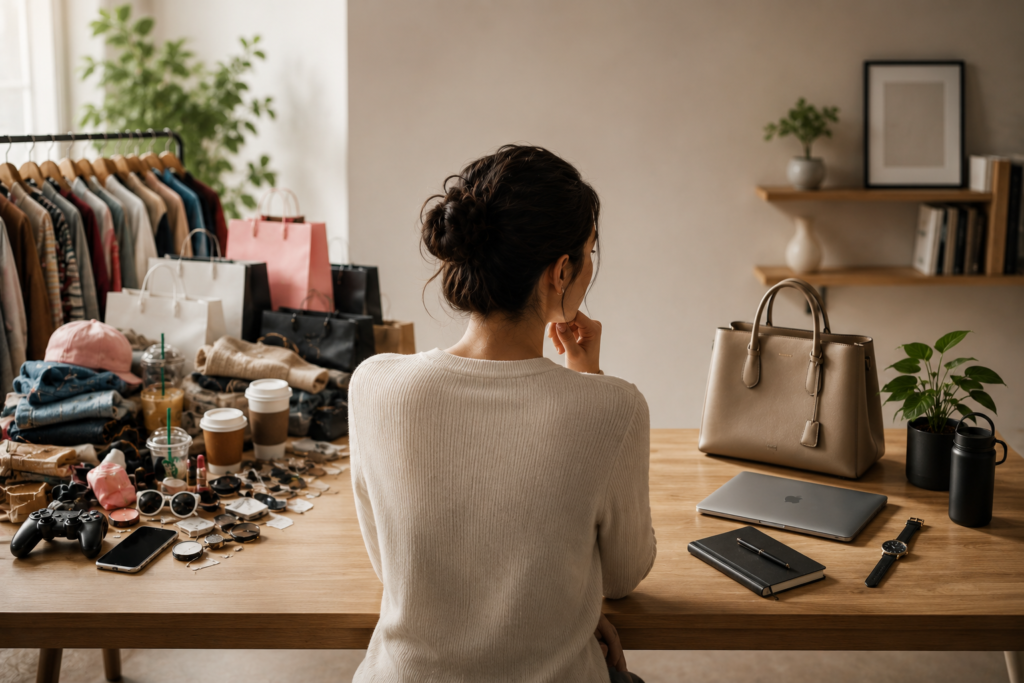
12. I Have Reduced Impulse Shopping
Minimalism has made me much more comfortable with waiting.
If I suddenly want something, I don’t always buy it immediately.
I give myself time to think.
Sometimes the desire disappears after a day or two.
This is why a simple 24-hour rule can be powerful.
For non-essential purchases, wait before buying.
If you still want it and it fits your budget and lifestyle, you can reconsider it.
Many impulse purchases don’t survive the waiting period.
13. I Don’t Shop to Change My Mood
Shopping can temporarily make us feel better.
A difficult day can make a new dress, gadget or home accessory feel exciting.
But the excitement doesn’t always last.
I’ve learned to look for other ways to deal with boredom, stress or frustration instead of automatically spending money.
This doesn’t mean I never buy anything enjoyable.
It simply means shopping isn’t my default form of entertainment.
14. I Borrow or Share When It Makes Sense
Not everything needs to be owned.
Some things are used so rarely that buying them doesn’t make financial sense.
Depending on the situation, I may:
- Borrow
- Rent
- Share
- Use an alternative I already own
This can be especially useful for occasional-use items.
Why spend money and dedicate storage space to something you’ll use once a year?
15. I Take Care of What I Own
Buying less doesn’t mean treating possessions carelessly.
Actually, the opposite happened.
When I own fewer things, I pay more attention to them.
I clean them.
Maintain them.
Store them properly.
Repair them when practical.
Taking care of your belongings can extend their useful life and delay replacement purchases.
16. I Don’t Upgrade Just Because Something New Exists
Technology and products are constantly being upgraded.
But a newer version doesn’t automatically mean I need it.
If something I own still works well and meets my needs, I don’t feel pressured to replace it.
I ask:
“What problem will this upgrade solve for me?”
If I can’t identify a meaningful improvement, I usually keep what I already have.
17. I Have Become More Selective About Clothes
Clothing can become a major source of unnecessary spending.
Instead of buying something simply because I like it in the shop, I consider:
- Do I already have something similar?
- Does it fit properly?
- Will I actually wear it?
- Is it suitable for my lifestyle?
- Do I really need it?
This has helped me move away from having a wardrobe full of clothes but very few things I actually want to wear.
18. I Don’t Buy Things to Impress Other People
This is perhaps one of the biggest financial benefits of minimalism.
When you stop worrying about whether your home, clothes, car or possessions look impressive to others, your spending can change dramatically.
You stop buying for comparison.
You stop upgrading just because someone else upgraded.
You stop thinking:
“What will people think?”
And start thinking:
“Does this make sense for me?”
That shift can save a lot of money.
19. I Focus on Experiences and Goals Instead of Stuff
Money that doesn’t go toward unnecessary possessions can be redirected toward things that matter more.
For example:
- Savings
- Investments
- Family experiences
- Travel
- Education
- Financial goals
- Building an emergency fund
Minimalism doesn’t mean never spending money.
It means spending intentionally.
I’d rather spend money on something that genuinely matters to me than accumulate things simply because I can afford them.
20. I Don’t Let a Small Price Fool Me
One of the easiest ways to overspend is to think:
“It’s only ₹100.”
₹100 doesn’t feel significant.
Neither does ₹200.
Neither does ₹500.
But repeated frequently, small purchases become a large amount.
That’s why I look at my spending as a whole rather than judging every purchase individually.
A ₹100 purchase isn’t necessarily bad.
But 100 unnecessary ₹100 purchases equal ₹10,000.
Small leaks can eventually become a big problem.
Check Vasanthi Shankar Digital Download store for Budgeting Template
21. I Keep My Home Inventory Low
The fewer things I own, the easier it is to know what I need.
This creates a positive cycle:
Less stuff → better visibility → fewer duplicate purchases → less spending → less clutter.
When cupboards are overflowing, it’s easy to forget what you own.
When everything has a place and there is some empty space, you can see what you actually have.
22. I Have Stopped Confusing Wants With Needs
Not everything I want is something I need.
And that’s completely okay.
I can want something without buying it.
This distinction has been very helpful:
Need
Something essential or genuinely important.
Want
Something I’d enjoy having.
Impulse
Something I suddenly want because I saw it, someone recommended it, or it was on sale.
The goal isn’t to eliminate wants.
It’s to make sure impulses don’t control my spending.
Check Vasanthi Shankar Digital Download store for Budgeting Template
23. I Budget for What Matters
Minimalism and budgeting work very well together.
My goal isn’t to reduce every expense.
Instead, I want my money to go toward the things that matter most to me.
A budget helps me decide:
Where should my money go?
Minimalism helps me decide:
What don’t I need to spend money on?
Together, they make spending much more intentional.
Check Vasanthi Shankar Digital Download store for Budgeting Template
24. I Think About the Long-Term Cost
Before buying something, I sometimes think beyond the price tag.
A ₹1,000 item may also require:
- Storage space
- Cleaning
- Maintenance
- Accessories
- Replacement parts
- Electricity
- Future upgrades
The purchase price is only part of the cost.
This is especially important with appliances, gadgets and products that require ongoing expenses.
25. I Enjoy the Freedom That Comes With Owning Less
Saving money is only one benefit I’ve experienced from minimalism.
The bigger benefit is freedom.
When I own fewer things:
- My home is easier to clean.
- My cupboards are easier to manage.
- I spend less time organising.
- I make fewer unnecessary purchases.
- I have less visual clutter.
- I feel less pressure to keep upgrading.
- More of my money can go toward my financial goals.
That’s why I don’t see minimalism as deprivation.
For me, it is about getting more value from the money I already earn.
A Simple Minimalist Money Rule
If you want to start combining minimalism with saving money, try this rule:
Before buying anything non-essential, ask:
1. Do I need it?
2. Do I already own something similar?
3. How often will I use it?
4. Where will I store it?
5. Would I buy it without the discount?
6. Can I wait 24 hours before buying it?
7. Would I rather use this money for one of my financial goals?
If you’re still confident that the purchase is worthwhile after answering these questions, go ahead.
But if you realise you don’t really need it, simply don’t buy it.
That’s money saved without feeling deprived.
Final Thoughts
Minimalism has taught me that saving money doesn’t always require complicated investment strategies.
Sometimes, it starts with something much simpler:
Stop buying things you don’t need.
Every unnecessary purchase avoided is money that can stay in your bank account, go toward investments, support a financial goal or simply give you more freedom.
I don’t want to spend my life constantly buying, organising, replacing and maintaining things.
I want my money and my possessions to support the life I actually want.
That’s what minimalist living means to me.
Own less. Buy intentionally. Spend on what matters. And let your money work for your future instead of constantly spending it on more stuff.
Vasanthi Shankar Digital download Store is Now Available Both in Instamojo & Shopify Platform
Shopify Link – https://vasanthi-shankar-digital-download-store.myshopify.com/
Join the membership for exclusive access to my real monthly budget & spending breakdown –https://www.youtube.com/channel/UCfAgW9MJUWn9wnnd9NSnlzQ/join
Vasanthi Shankar Amazon Store Front Link – https://www.amazon.in/shop/mrs.shankarsrecipes
Vasanthi Shankar WhatsApp Channel – https://www.whatsapp.com/channel/0029VaBNmt22v1IqxpnjLr2W