Introduction
Does this sound familiar?
You’re ready to declutter your home, but your spouse keeps buying new things. Your children leave toys everywhere. Every time you try to let go of something, someone says, “Don’t throw that away—we might need it someday.”
If you’re waiting for your entire family to become minimalists before you begin, you may end up waiting forever.
The good news? You don’t need everyone to change before your home starts changing.
Over the last few years, I’ve learned that decluttering isn’t about controlling other people. It’s about focusing on what you can control. Here are 12 practical tips that helped me create a calmer home—even when my family wasn’t interested.
1. Start With Your Own Belongings
The easiest place to begin is with your own things.
Go through your clothes, books, handbags, cosmetics, paperwork, and sentimental items. Every item you let go of creates more space without affecting anyone else.
When your family sees the positive changes in your own life, they’re far more likely to become curious than if you constantly ask them to declutter.
2. Never Declutter Someone Else’s Things Without Permission
It can be tempting to secretly donate your spouse’s old clothes or throw away your child’s broken toys.
Don’t.
Decluttering someone else’s belongings usually leads to arguments and breaks trust. Instead, respect their ownership and focus only on what belongs to you—unless they ask for your help.
3. Be the Example, Not the Teacher
You don’t need to give lectures about minimalism.
Simply let your actions speak.
When your wardrobe is easier to manage, your kitchen stays cleaner, and your mornings become less stressful, your family will notice the difference.
People are inspired by results, not advice.
If you’re looking for a step-by-step system, check out my Whole House Decluttering Checklist, available in both Tamil and English in the Vasanthi Shankar Digital Download Store.
4. Create Clutter-Free Zones
You don’t have to keep the entire house perfect.
Instead, choose one or two spaces that always stay clutter-free.
- Your bedroom
- The dining table
- The kitchen countertop
- Your workspace
These small, peaceful areas can make your entire home feel calmer, even if other rooms aren’t perfect.
5. Use the Container Method
This is one of my favourite decluttering methods.
Every category should have a fixed amount of space.
For example:
- One bookshelf
- One toy basket
- One kitchen drawer
Once the container is full, something has to leave before something new comes in.
This simple rule naturally limits clutter without forcing anyone to get rid of everything.
6. Stop Buying Unnecessary Things Yourself
Many people try to declutter while continuing to shop.
That only makes the process harder.
Before buying anything, ask yourself:
- Do I already own something similar?
- Will I actually use it?
- Where will I keep it?
Buying less is often more powerful than decluttering more.
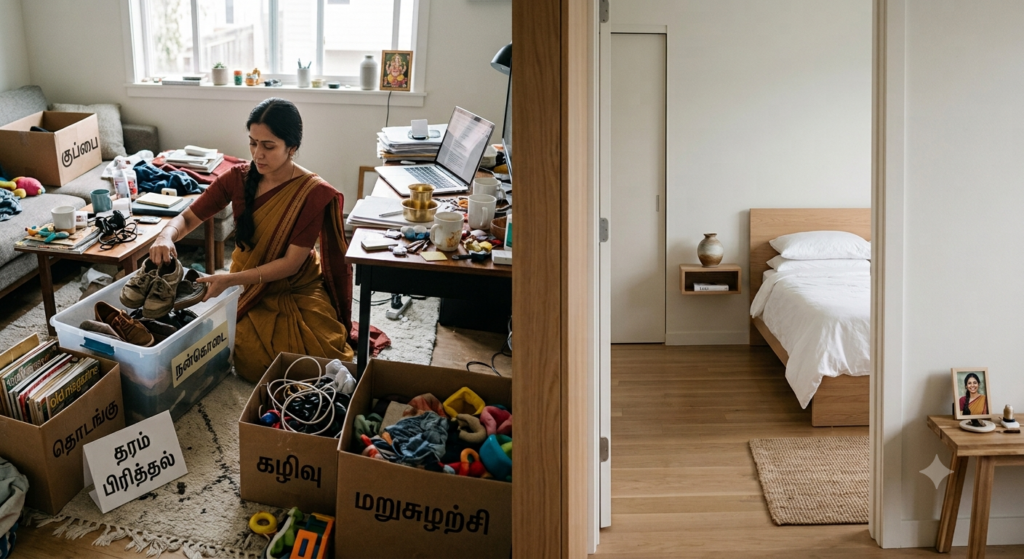
7. Make Decluttering Less Emotional
Instead of asking,
“Should we throw this away?”
Try asking,
“When was the last time we used this?”
Questions like this shift the focus from emotions to usefulness, making decisions much easier.
8. Involve Children in Small Decisions
Don’t expect children to declutter an entire room.
Start with simple choices.
Ask questions like:
- Which five toys do you play with the most?
- Which books do you still enjoy?
- Which clothes no longer fit?
These small decisions teach lifelong habits.
Today, my 8-year-old often says things like, “Mom, I don’t enjoy this toy anymore,” or “These trousers are tight. Let’s declutter them.”
That habit wasn’t built in a day—it developed by involving him in small decisions over time.
9. Celebrate Progress, Not Perfection
Maybe one room is still messy.
Maybe the loft is still full.
That’s okay.
Every drawer you simplify, every shelf you clear, and every unnecessary purchase you avoid is progress.
A peaceful home is built one small step at a time.
10. Accept Different Comfort Levels
Not everyone has the same relationship with possessions.
Some people are comfortable owning very little.
Others feel more secure keeping extra things.
Your goal isn’t to make everyone a minimalist.
Your goal is to create a home that works well for your family.
Respecting different comfort levels often leads to more cooperation than forcing change.
11. Focus on Daily Habits
Don’t wait for one big decluttering weekend.
Instead, build simple daily habits:
- Put things back after using them.
- Clear the dining table every night.
- Donate one item each week.
- Follow the “One In, One Out” rule.
Small habits create lasting results.
12. Remember What You’re Really Trying to Create
Decluttering isn’t about empty shelves.
It’s about creating a home that’s easier to clean, easier to maintain, and more enjoyable to live in.
When your family experiences less stress, fewer arguments, and more peace, they’ll naturally become more open to decluttering.
That’s exactly what happened in my family. Over time, my husband, my in-laws, and even my sister started changing—not because I convinced them, but because they experienced the benefits themselves.
Real change is often caught, not taught.
Conclusion
If your family doesn’t help with decluttering, don’t lose motivation.
Start with your own belongings. Respect other people’s choices. Focus on small, consistent habits instead of trying to change everyone overnight.
Remember, you can’t control someone else’s decisions—but you can control your own.
And very often, one person’s quiet consistency inspires the entire family.
Because a clutter-free home doesn’t require a perfect family.
It simply requires one person willing to begin.
Vasanthi Shankar Digital download Store
Link – https://vasanthi-shankar-digital-download-store.myshopify.com/
Join the membership for exclusive access to my real monthly budget & spending breakdown –https://www.youtube.com/channel/UCfAgW9MJUWn9wnnd9NSnlzQ/join
Vasanthi Shankar Amazon Store Front Link – https://www.amazon.in/shop/mrs.shankarsrecipes
Vasanthi Shankar WhatsApp Channel – https://www.whatsapp.com/channel/0029VaBNmt22v1IqxpnjLr2W