Decluttering is the process of removing unused and unwanted things from your home and environment. It’s about intentionally choosing what truly adds value to your life and letting go of what doesn’t. Since everyone’s lifestyle, space, and emotional attachment to belongings are different, there is no one-size-fits-all approach.
Here’s a refined and practical list of proven decluttering methods you can choose from—or mix and match—to suit your lifestyle.
1. The KonMari Method
Created by: Marie Kondo
Book: The Life-Changing Magic of Tidying Up
This was my first inspiration to start decluttering. Marie Kondo is a Japanese decluttering and organizing expert, and her method focuses on joy.
How it works:
- Declutter by category, not by room (clothes, books, papers, komono/miscellaneous, sentimental items)
- Gather everything from one category in one place
- Hold each item and ask: “Does this spark joy?”
- Keep only what sparks joy and thank the rest before letting go
Best for: Emotional decluttering and people who feel deeply attached to their belongings
2. The Minimalist Game (30-Day Challenge)
Created by: The Minimalists
This is a fun and motivating challenge-style method. The Minimalists also have books and a documentary available on their YouTube channel.
How it works:
- Day 1: Remove 1 item
- Day 2: Remove 2 items
- Continue this until Day 30 (a total of 465 items)
Best for: Beginners, families, and people who need motivation
3. Room-by-Room Decluttering
A classic and practical approach—and one of my personal favourites. This method works well for most households.
How it works:
- Choose one room at a time
- Finish decluttering that room completely before moving to the next
- Start with visible clutter like tables, shelves, and floors
Best for: Busy people and practical thinkers
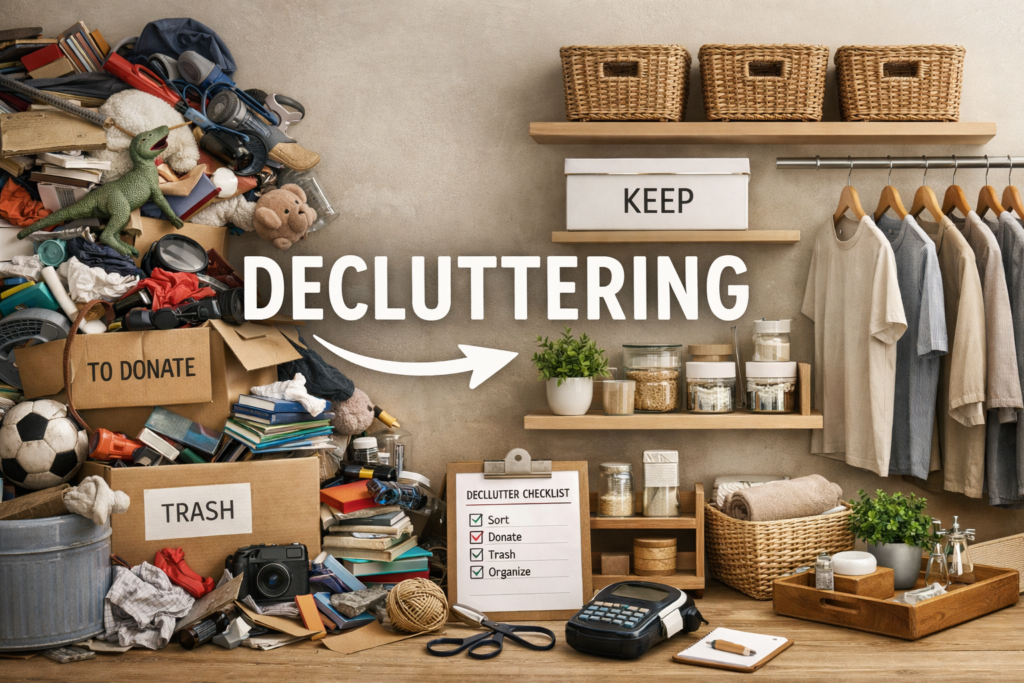
4. The Four-Box Method
A simple and effective decision-making system.
How it works:
Keep four boxes or bags labelled as below. Choose a space to declutter and place every item into one of these boxes.
Boxes labelled:
- Keep
- Donate
- Trash
- Relocate
This method makes decision-making easy and decluttering feel less overwhelming.
Best for: Quick decluttering sessions and indecisive people
5. The One-Year Rule
If you haven’t used an item in the past year, it’s time to let it go. This rule is especially useful for items stored in lofts or storage rooms.
Exceptions:
- Emergency items
- Seasonal items
- Sentimental items
- Genuine “just-in-case” items
Best for: Clothes, gadgets, kitchen items

6. The 12-12-12 Challenge
A fast and effective method that works well as a daily habit or quick chore.
How it works:
- Find 12 items to throw away
- Find 12 items to donate
- Return 12 items to their proper place
Over time, this becomes a simple and powerful decluttering habit.
Best for: Quick resets, weekends, and working people
7. The Packing Party Method
Live as if you’re moving. This is an extreme but highly effective approach.
How it works:
- Pack almost everything you own into boxes
- Unpack only what you actually use
- After 30–60 days, donate or discard unopened boxes
This method is especially helpful if you’re relocating or planning a major lifestyle change.
Best for: Radical decluttering and big transitions
8. The Surface Decluttering Method
This method focuses only on visible areas. I often recommend starting here because seeing clutter-free spaces instantly boosts motivation.
How it works:
- Clear countertops, tables, beds, and floors
- Ignore hidden storage areas initially
Best for: Immediate visual calm and mental clarity
9. The Sentimental Decluttering Method
This method is designed for emotionally difficult items. I personally used this approach while decluttering my late parents’ belongings.
Tips:
- Take photos before letting go
- Keep a small memory box
- Choose the best items, not all of them
Best for: Photos, gifts, and childhood memories
10. The Daily Declutter Habit
Small actions done consistently can create long-term change. This is a slow but sustainable process.
Examples:
- Declutter 5 items per day
- Follow the 10-minute declutter rule
- Practice the one-in-one-out rule
Best for: Long-term clutter prevention
11. Digital Decluttering Method
Decluttering isn’t just about physical space—your digital space matters too. Cal Newport’s book Digital Minimalism focuses entirely on this topic.
Declutter:
- Emails
- Phone apps
- Photos
- Files and folders
Best for: Mental clarity and productivity
How to Choose the Right Decluttering Method
Ask yourself:
- Do I want fast results or long-term change?
- Am I emotionally attached to my belongings?
- Do I prefer structure or flexibility?
You don’t need to stick to just one method. You can mix multiple methods—just like I do. And remember, always declutter first and organize later.
Final Thoughts
Decluttering is not a one-time project—it’s a skill you build over time. Start small, be kind to yourself, and move at your own pace.
A clutter-free space supports a clutter-free mind. If you found this guide helpful, bookmark it or share it with someone who feels overwhelmed by clutter.
Check out my comprehensive 26-page Whole House Decluttering Checklist, designed to guide you through decluttering every area of your home
Vasanthi Shankar Digital download Store
Link – https://vasanthishankar.myinstamojo.com/
Vasanthi Shankar Amazon Store Front Link – https://www.amazon.in/shop/mrs.shankarsrecipes
Vasanthi Shankar WhatsApp Channel – https://www.whatsapp.com/channel/0029VaBNmt22v1IqxpnjLr2W
Things I use for filming my videos- https://amzn.to/4ausvPC